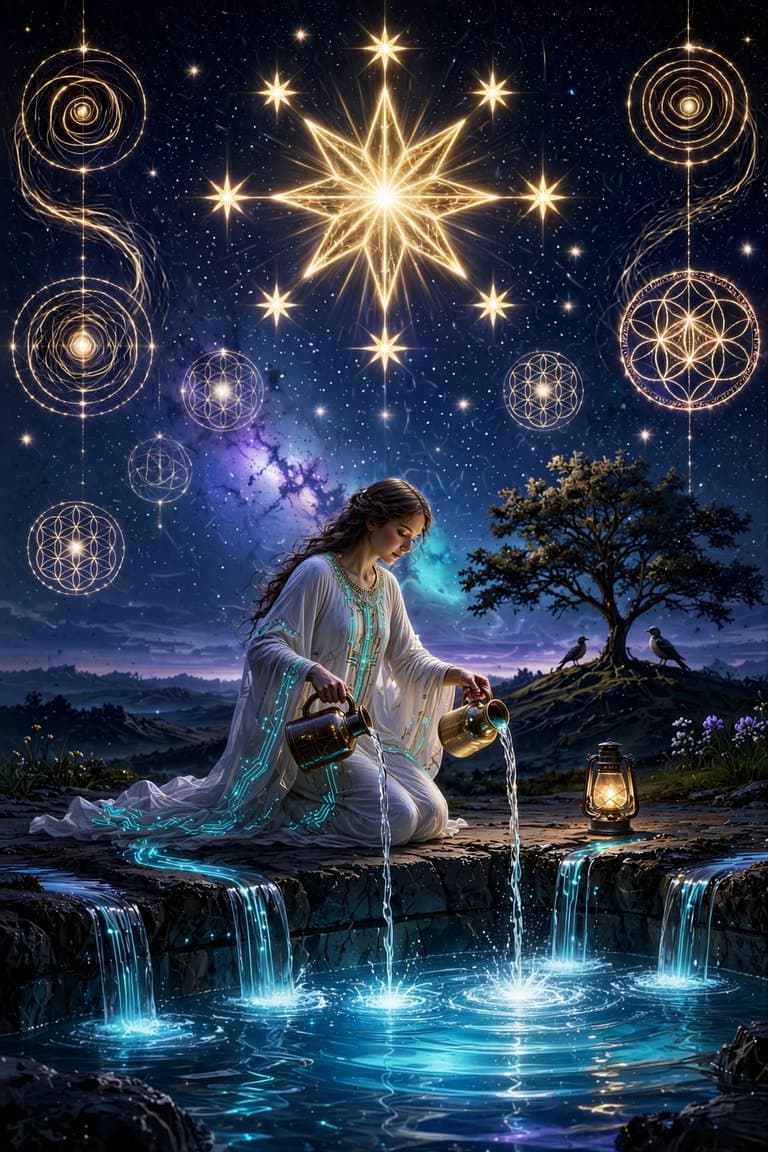
The Star
Tarot card meaning, upright and reversed
What it means
Upright
The Star is read as hope after the storm: renewal, calm and faith in what comes next. Waite noted two readings: loss and abandonment in one, hope and bright prospects in the other.
Reversed
Reversed, it is read as discouragement or lost faith. Waite gave arrogance, haughtiness and impotence.
In love
Hope in love, healing relationships, soulmate connection.
In work
Hope for future, inspired work, healing after crisis.
What is drawn on the card
A naked woman kneels by a pool under a great eight-pointed star and seven smaller ones. She pours water from one jug into the pool and from another onto the land; a bird sits in a tree behind her.
As Pamela Colman Smith drew it in 1909. Our paintings follow these scenes.
- Hebrew letter
- Tzaddi
- Sign
- Aquarius
The letter and sign are 19th-century occult attributions (Golden Dawn), not part of the card’s origin.
Where the card comes from
- Tarot began as a card game in 15th-century Italy. The earliest record is from Florence in 1440, and the game is still played today in France, Austria and Bologna.
- Reading the cards for fortunes is documented from Bologna around 1750, with ordinary playing decks.
- In 1781 Antoine Court de Gébelin wrote that the cards came from ancient Egypt. There is no evidence for it, and he wrote before anyone could read hieroglyphs (1822).
- The Hebrew letters and astrological signs on each card are 19th-century French and English occult attributions; the Hermetic Order of the Golden Dawn (founded 1888) fixed the set most readers use.
- The scenes follow the 1909 Waite–Smith deck, designed by A. E. Waite and drawn by Pamela Colman Smith. The Innerverse cards are our own paintings of those scenes.
Sources: Michael Dummett, The Game of Tarot (1980); Morgan Library & Museum, Visconti-Sforza tarot, MS M.630; Court de Gébelin, Le Monde primitif, vol. VIII (Paris, 1781); A. E. Waite, The Pictorial Key to the Tarot (1911).
Draw your own card
The Star is one of 78. Draw one card or a three-card spread in the Innerverse, read with the same art and the same sources, free.
Or make it daily: one card each morning, with a private note →Want the whole deck? All 78 cards and the guidebook.
Traditional readings, presented as tarot readers have held them. They are a record of a practice, not a prediction.