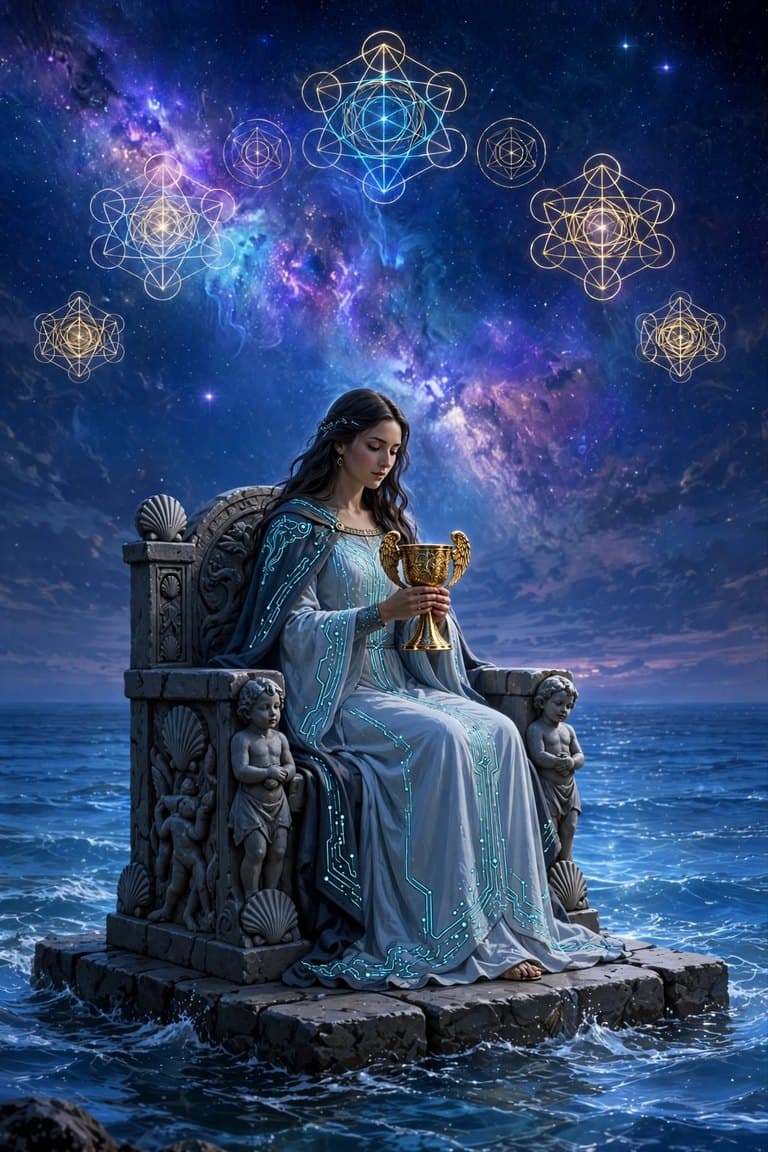
Queen of Cups
Tarot card meaning, upright and reversed
What it means
Upright
This card is read as deep compassion and emotional wisdom: someone who listens well and feels deeply without losing herself. Waite called her a good, fair woman with a gift of vision.
Reversed
Reversed, it is read as emotional overwhelm, codependence, or caring for others at the expense of self.
A question to sit with
Who needs you to listen without fixing? And who is listening to you?
The deeper reading
Traditionally water mastered from within: feeling that is felt fully and held steady.
What is drawn on the card
A queen sits on a throne at the water's edge, gazing into an ornate covered cup with angel handles. Small sea-children decorate her throne, and pebbles line the shore at her feet.
As Pamela Colman Smith drew it in 1909. Our paintings follow these scenes.
- Suit
- Cups
- Element
- Water
- Domain
- Emotions, relationships, intuition
Where the card comes from
- Tarot began as a card game in 15th-century Italy. The earliest record is from Florence in 1440, and the game is still played today in France, Austria and Bologna.
- Reading the cards for fortunes is documented from Bologna around 1750, with ordinary playing decks.
- In 1781 Antoine Court de Gébelin wrote that the cards came from ancient Egypt. There is no evidence for it, and he wrote before anyone could read hieroglyphs (1822).
- The Hebrew letters and astrological signs on each card are 19th-century French and English occult attributions; the Hermetic Order of the Golden Dawn (founded 1888) fixed the set most readers use.
- The scenes follow the 1909 Waite–Smith deck, designed by A. E. Waite and drawn by Pamela Colman Smith. The Innerverse cards are our own paintings of those scenes.
Sources: Michael Dummett, The Game of Tarot (1980); Morgan Library & Museum, Visconti-Sforza tarot, MS M.630; Court de Gébelin, Le Monde primitif, vol. VIII (Paris, 1781); A. E. Waite, The Pictorial Key to the Tarot (1911).
Draw your own card
Queen of Cups is one of 78. Draw one card or a three-card spread in the Innerverse, read with the same art and the same sources, free.
Or make it daily: one card each morning, with a private note →Want the whole deck? All 78 cards and the guidebook.
Traditional readings, presented as tarot readers have held them. They are a record of a practice, not a prediction.