Mictlan, the Mexica Land of the Dead
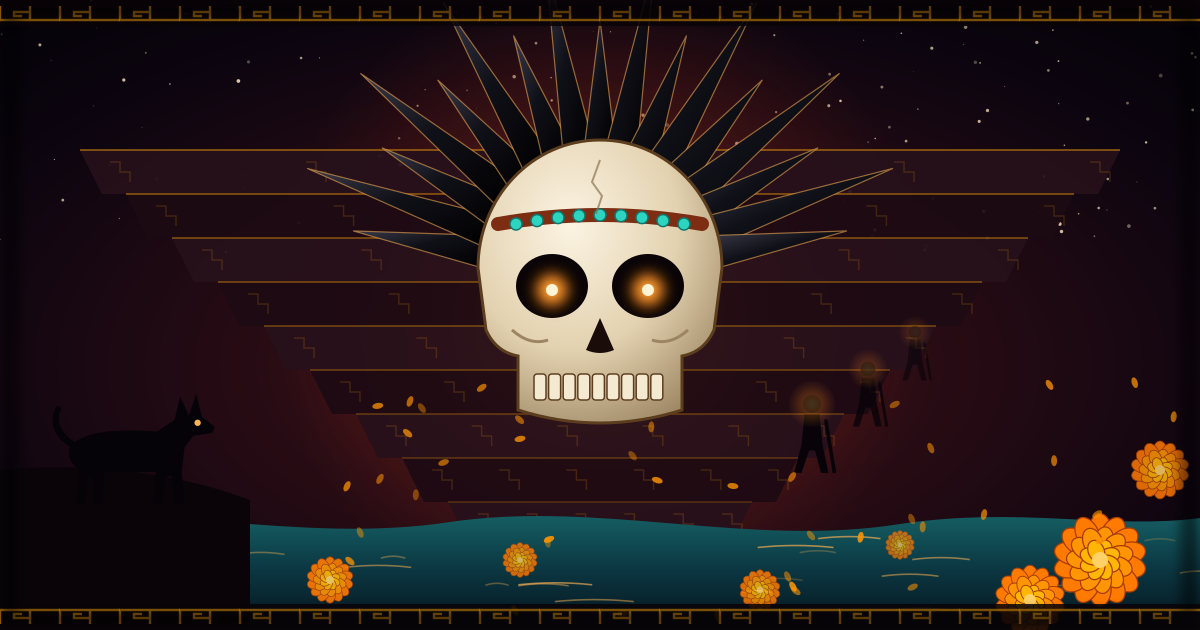
For the Mexica, where you went when you died depended on how you died, not how you lived. Ordinary deaths went to Mictlan: a four-year road that ended at a river you could cross only on the back of a dog burned with you.
Also known as: Mictlán · Aztec underworld · Day of the Dead origins · Día de Muertos · Dia de los Muertos · Mictlantecuhtli · Mictecacihuatl · nine levels of the Aztec underworld · Xolo dog afterlife · La Catrina origin
 AI illustration (Meta AI): an artist's impression, not a reconstruction.
MICTLAN — THE MEXICA LAND OF THE DEAD, AND WHAT DAY OF THE DEAD KEPT FROM IT
UET Library Encyclopedia Entry
| Alignment Score | Tier | Category |
|---|---|---|
| 85% | RITUAL | Ancient Traditions |
Classification: Afterlife geography | Funeral practice | The pre-Hispanic layer under Día de Muertos Primary Designation: Mictlan · ruled by Mictlantecuhtli and Mictecacihuatl Sources: Sahagún, Florentine Codex, Book 3 appendix (compiled about 450 years ago); Codex Vaticanus A (Ríos); Durán, Book of the Gods and Rites; Brandes, Skulls to the Living, Bread to the Dead (2006) Status: The four destinations and the four-year road are stable in the Nahua sources. The number and order of the stages on the road are not, and this entry shows both lists
EXECUTIVE SUMMARY
For the Mexica, where you went when you died depended on how you died, not on how you had lived. Warriors killed in battle or on the sacrificial stone, and women who died giving birth, went to the house of the Sun. The drowned and the lightning-struck went to Tlalocan, the green paradise of the rain god. Infants who died nursing went to a tree that dripped milk. Everyone else, ruler or farmer, who died an ordinary death of age or illness, went to Mictlan.
Getting there took four years. The road ran through clashing mountains, a serpent, deserts, and a wind of obsidian blades, and ended at a river the dead could cross only on the back of a dog burned with them for the purpose. At the end waited the lord and lady of the dead.
Día de Muertos, observed on November 1 and 2, carries part of this. It also carries the Catholic calendar, Spanish confectionery, and a 20th-century cartoon. This entry separates the layers and shows the receipt for each.
WHO WENT WHERE

| Destination | Who went there | What it was |
|---|---|---|
| Tonatiuh Ichan, house of the Sun | Warriors killed in battle or sacrifice; women who died in childbirth | The men escorted the sun from dawn to noon, the women from noon to sunset. After four years the warriors returned as hummingbirds and butterflies |
| Tlalocan, Tlaloc's place | The drowned, the lightning-struck, those killed by water-linked diseases | A land of endless growing season. These dead were buried, not burned |
| Chichihuacuauhco, the wet-nurse tree | Infants who died still nursing | A tree whose branches dripped milk, where they waited to be reborn |
| Mictlan, the place of the dead | Everyone else: ordinary death, by age or illness | The deepest and most common destination. Neither reward nor punishment |
The categories vary a little between sources, but the principle does not: the sorting is by the manner of death. Mictlan was not a hell. A respected ruler who died of fever went there, the same as a farmer.
THE ROAD: FOUR YEARS, AND A DOG
Sahagún's Nahua informants described what the family did at a death: the body was dressed, given water for the road and paper offerings for each danger, and burned with a small dog killed for the journey, a cotton cord around its neck.
The dead then walked for four years. The informants list the dangers in order: two mountains that clash together, a road guarded by a serpent, a green lizard, eight deserts, eight hills, a wind of obsidian blades, and finally a wide river. At the river the dog waited. In the Florentine account, only a yellow dog would carry its master across: a white dog would refuse because it had just washed, a black one because it had just dirtied itself. On the far side, the dead presented their offerings to Mictlantecuhtli, and after that they were gone.
Two lists of the road, which this entry does not merge:
- The Florentine Codex gives a sequence of trials, about eight, ending at the lord of the dead.
- The Codex Vaticanus A, painted in the 1560s, is the only surviving source that draws Mictlan as nine stacked levels. The popular "nine levels of the Aztec underworld" comes from it.
The two do not match stage for stage. Both are early colonial records of a living tradition, and the disagreement is part of the record.
THE FEASTS OF THE DEAD WERE IN SUMMER
The Mexica solar year had eighteen months of twenty days. Two of them belonged to the dead: Miccailhuitontli, "the little feast of the dead," and Hueymiccailhuitl, "the great feast of the dead." Durán names them, and Sahagún records the same months under other names (Tlaxochimaco and Xocotl Huetzi). By the usual correlations they fell around August.
November 1 and 2 are All Saints' Day and All Souls' Day, the Catholic feasts for the saints and for all the faithful dead. The friars brought them, and over the colonial centuries the remembrance of the dead moved onto the church's dates. What Mexicans observe today grew from both: the indigenous habit of feeding and welcoming the dead, held on the Catholic calendar.
WHAT IS PRE-HISPANIC, WHAT IS COLONIAL, WHAT IS MODERN
| Element | Layer | Receipt |
|---|---|---|
| Offerings of food and drink to the dead | Both | Nahua funeral offerings (Florentine Book 3); Spanish All Souls' customs of bread and candles for the dead |
| Marigold, cempasúchil | Pre-Hispanic name and use | Nahuatl cempōhualxōchitl, "twenty flower," for its many petals |
| Skull imagery | Pre-Hispanic and modern | The tzompantli skull racks of the Templo Mayor; the modern calavera is a separate, later tradition |
| November 1–2 | Colonial | The Catholic feasts of All Saints and All Souls |
| Sugar skulls | Colonial | Spanish sugar-molding technique (alfeñique); Brandes traces the confectionery to European craft |
| Pan de muerto | Colonial | Wheat bread, a European crop, shaped for the occasion |
| La Catrina | Modern | José Guadalupe Posada's satirical print La Calavera Garbancera, about 1910–1913, mocking Mexicans who dressed as Europeans. Diego Rivera put her in his 1947 mural and the name Catrina stuck |
| The holiday as a national symbol | Modern | 20th-century nationalism, then UNESCO's listing of the "Indigenous festivity dedicated to the dead" (proclaimed 2003, inscribed 2008) |
A popular story to keep, with its correction: La Catrina is often said to be Mictecacihuatl, the lady of Mictlan, in a hat. The figure is Posada's, and its first meaning was a joke about class. The seed is real: a female ruler of the dead stood beside Mictlantecuhtli long before Posada drew a skeleton in a hat, and the new figure fell into a place the old one had left.
THE ANTHROPOLOGICAL READING
The record does not let us say Mictlan was "real" or "made up." It lets us say what the Mexica recorded and what they did. Two things stand out.
The sorting by manner of death is unusual. Most afterlife systems that reach us through missionaries are recast as moral: the good rise, the bad fall. The Nahua sources resisted that recasting. The friars recorded, often with discomfort, a system in which a woman who died in childbirth stood with the greatest warriors, and a pious man who died of illness went to the same place as a thief.
The dog appears across the Americas. Burials with dogs reach back thousands of years in the hemisphere, and in western Mexico the Colima ceramic dogs placed in shaft tombs are about 2,000 years old. The Mexica account of a dog that carries its master over a river is one recorded version of a much older and wider idea: that the dead need a companion who knows the way.
SOURCES
Primary
- Bernardino de Sahagún, Florentine Codex (General History of the Things of New Spain), Book 3, appendix, chapters 1–3: the destinations, the road, the dog. Compiled 1545–1577
- Codex Vaticanus A (Codex Ríos), c. 1560s: the nine-level diagram of Mictlan
- Diego Durán, Book of the Gods and Rites and the Ancient Calendar, 1570s: Miccailhuitontli and Hueymiccailhuitl
- José Guadalupe Posada, La Calavera Garbancera, c. 1910–1913; Diego Rivera, Dream of a Sunday Afternoon in the Alameda Central, 1947
Scholarly
- Stanley Brandes, Skulls to the Living, Bread to the Dead: The Day of the Dead in Mexico and Beyond (2006); and "Sugar, Colonialism, and Death: On the Origins of Mexico's Day of the Dead," Comparative Studies in Society and History (1997)
- Miguel León-Portilla, Aztec Thought and Culture (1963)
- UNESCO, "Indigenous festivity dedicated to the dead," Representative List of the Intangible Cultural Heritage of Humanity (2008)
UET Library · Mesoamerica series · Related: The Five Suns, The New Fire Ceremony, Templo Mayor, The Mexica
Related entries
Civilizational Science
Energy, food, money and the long patterns underneath them. Every claim carries its source and its evidence tier. Free, and it stays free.
No charge, and no paywall on the dispatches. Unsubscribe in one click.